ABOUT
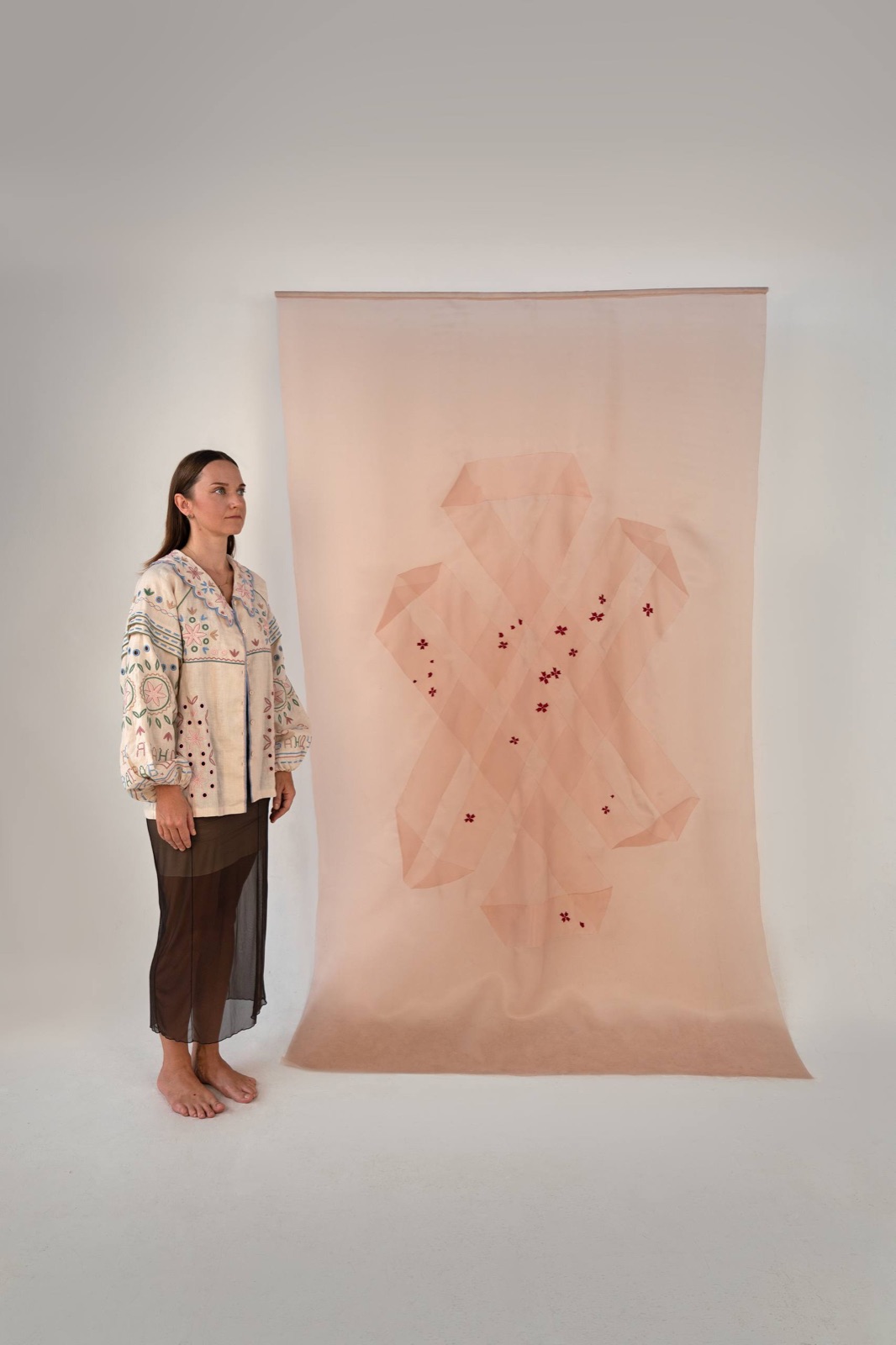
Organza does not hold what it carries. It has no color of its own, no pattern, no claim. Against a window it becomes transparent; against a wall, faintly luminous. In both states it simply allows form to arise within it — and then lets it go.
I am Ukrainian, living in Asia, working with two traditions — Ukrainian folk art, from embroidery to vytynanka, and Tibetan Buddhist visual structure. One was inherited through family and land; the other came through years of study and practice. I work with both not as sources of inspiration, but as languages I actually speak. In making these works, I found that both traditions share a single underlying logic: marking a surface with sacred form is not decoration. It is a way of organizing attention.
Today, as cultural forms travel faster than ever — through wars, migrations, algorithms — the question of how form moves and what it preserves in transit has stopped being academic.
In painting on organza, I layer sheets of transparent fabric and cut voids into them — a method rooted in Ukrainian vytynanka, where form emerges not through addition but through removal. Ukrainian ornament and Tibetan sacred geometry meet on a single surface — not in hierarchy, not in synthesis, but in genuine coexistence. Each tradition remains itself. And each is changed by the presence of the other.
Organza does not illustrate this idea. It embodies it. The thread marks the surface. The surface remains open. Form appears — suspended, weightless, without permanent ground — and the fabric holds it without grasping.
I am interested in a material that carries meaning without claiming it.